
- Admissions
-
Academics
- College of Arts & Sciences
- Pamplin School of Business Administration
- School of Education
- Donald P. Shiley School of Engineering
- School of Nursing
- Graduate School
- Library
- Provost
- Registrar
- Center for Entrepreneurship
- Garaventa Center
- Academic Advising
- Early Alert
- Fellowships & Grants
- Honors Program
- Majors & Minors
- Studies Abroad
- University Catalog: The Bulletin
- Air Force ROTC
- Army ROTC
-
Campus Life
- Arts & Culture
- Campus Ministry
- Counseling & Health Center
- Dining
- Housing & Residence Life
- International Student Services
- Moreau Center for Service & Leadership
- Portland, OR
- Public Safety
- Recreational Services
- Shepard Freshman Resource Center
- Student Activities
- Student Affairs
- Student Resources
- Sustainability
- Services
- Athletics
- About UP
- Home >>
- Library >>
- Find Articles >>
- Hawaii Immersion Resources
- Library
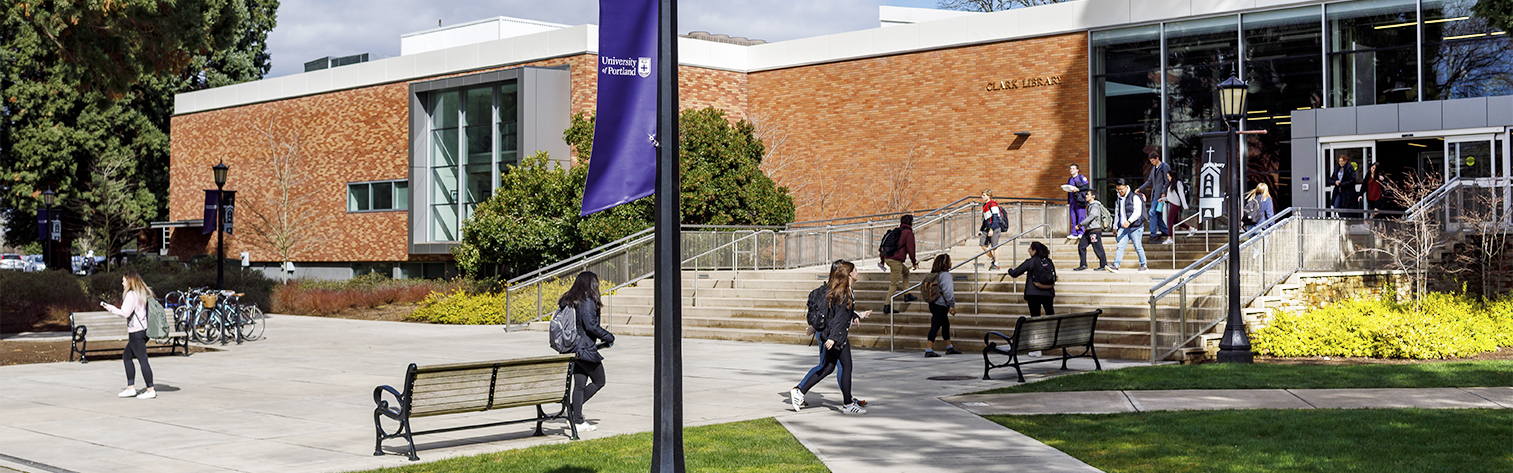
- Wilson W. Clark Memorial Library
- 5000 N Willamette Blvd.
- Portland OR 97203
- 503-943-7111 or 800-841-8261
- fax: 503-943-7491
- library@up.edu
Library
|
|
The resources below have been selected to support the University of Portland's Hawaii Immersion program. The annotations are drawn from a variety of review and summary sources.
Bunson, M., & Bunson, M. (2009). St. Damien of Molokai: Apostle of the exiled. Huntington, IN: Our Sunday Visitor.
Recounts the life of Saint Damien of Molokai, a humble Congregation of
the Sacred Hearts priest who found a vocation in
caring for lepers that led him to his
upcoming canonization in October 2009.
Englebert, O. (1994). Damien, hero of Molokai (3rd ed.). Boston, MA: St. Paul Books & Media.
Biography of the life of Father Damien, who served as a priest to the lepers on Molokai.
Kameʻekua, K., Lee, P. J., & Willis, K. (1988). Tales from the night rainbow = Moʻolelo o na pō mākole : the story of a woman, a people, and an island : an oral history. Honolulu: Night Rainbow Pub. Co.
This book recounts the oral history of the Kai’akea family of the Mo’o Clan of Moloka’i, which traces its roots back to an estimated 800 B.C. These stories are recorded as told by Kaili’ohe Kame’ekua of Kamalo, Molokai (1816–1931).
Kauanui, J. K. (2008). Hawaiian blood:
Colonialism and the politics of sovereignty and indigeneity. Durham, NC: Duke University Press.
In 1921 the U.S. Congress officially defined "native Hawaiians" as
those people "with at least one-half blood quantum of individuals
inhabiting the Hawaiian Islands prior to 1778." This "blood logic" has
since become an entrenched part of the legal system in Hawai`i, and it
has had a profound effect on cultural definitions of indigeneity,
transforming notions of kinship and belonging among Native Hawaiians
(Kanaka Maoli).
Kimura, Y. (1988). Issei: Japanese
immigrants in Hawaii. Honolulu: University of Hawaii Press.
Coming to Hawaii before July 1, 1924, when the Japanese Exclusion Act
became effective, the experiences of the Issei or first generation of Japanese immigrants are
described.
Law, A. S. (2012). Kalaupapa: A collective memory. Honolulu: University of Hawaiʻi Press. Between 1866 and 1969, an estimated 8,000 individuals at least 90 percent of whom were Native Hawaiians were sent to Molokai s remote Kalaupapa peninsula because they were believed to have leprosy. Unwilling to accept the loss of their families, homes, and citizenship, these individuals ensured they would be accorded their rightful place in history. They left a powerful testimony of their lives in the form of letters, petitions, music, memoirs, and oral history interviews. Kalaupapa: A Collective Memory combines more than 200 hours of interviews with archival documents, including over 300 pages of letters and petitions written by the earliest residents that have been translated from Hawaiian.
Liliuokalani. (1964). Hawaii's story by Hawaii's Queen.
Rutland, VT: C.E. Tuttle Co.
Written by Queen Liliuokalani, the last monarch of the Kingdom of
Hawaii, this book was published in 1898, five years after the overthrow
of the Kingdom. Liliuokalani gives her account of her upbringing, her
ascension to the throne, and her overthrow.
McGregor, D. (2007). Na kua'aina : Living Hawaiian culture. Honolulu: University of Hawai'i Press.
The word kua‘âina translates literally as “back land” or “back
country.” Davianna Pômaika‘i McGregor grew up hearing it as a reference
to an awkward or unsophisticated person from the country. However, in
the context of the Native Hawaiian cultural renaissance of the late
twentieth century, kua‘âina came to refer to those who actively lived Hawaiian culture and kept the spirit of the land alive. The mo‘olelo (oral traditions) recounted in this book reveal how kua‘âina
have enabled Native Hawaiians to endure as a unique and dignified
people after more than a century of American subjugation and control.
The stories are set in rural communities or cultural kîpuka—oases from which traditional Native Hawaiian culture can be regenerated and revitalized.
Okihiro, G. Y. (2008). Island world: A history of Hawai'i and the United States. Berkeley: University of California Press.
Brilliantly mixing geology, folklore, music, cultural commentary, and
history, Gary Y. Okihiro overturns the customary narrative in which the
United States acts upon and dominates Hawai'i. Instead, Island World
depicts the islands' press against the continent, endowing America's
story with fresh meaning. Okihiro's reconsidered history reveals
Hawaiians fighting in the Civil War, sailing on
nineteenth-century New England ships, and living in pre-gold rush
California. He points to Hawai'i's lingering effect on
twentieth-century American culture-from surfboards, hula, sports, and
films, to art, imagination, and racial perspectives-even as the islands
themselves succumb slowly to the continental United States. In placing
Hawai'i at the center of the national story, Island World rejects the
premise that continents comprise "natural" states while islands are
"tiny spaces," without significance, to be acted upon by continents. An
astonishingly compact tour de force, this book not only revises the way
we think about islands, oceans, and continents; it also recasts the way
we write about space and time.
Tayman, J. (2006). The colony. New York, NY: Scribner.
Reveals the untold history of
the infamous American leprosy colony on Molokai and of the
extraordinary people who struggled to survive under the most horrific
circumstances. Tracked by bounty hunters and torn screaming from their
families, the luckless were loaded into shipboard cattle stalls and
abandoned in a lawless place where brutality held sway. Many did not
have leprosy, and most of those who did were not
contagious, yet all were caught in a shared nightmare. The colony had
little food, little medicine, and very little hope. Exile continued for
more than a century, the longest and deadliest instance of medical
segregation in American history. Nearly 9,000 people were banished to
the colony, trapped by pounding surf and armed guards and the highest
sea cliffs in the world. 28 live there still.
Volder, J. . (2010). The spirit of Father Damien: The leper priest--a saint for our time. San Francisco: Ignatius Press.
Belgian historian and journalist Jan De Volder sifted through Father Damien's personal correspondence as well as the Vatican archives, following Father Damien's transformation from the stout, somewhat haughty missionary of his youth, bounding from Europe to Hawaii and straight into seemingly tireless priestly work, to the humble and loving shepherd of souls who eventually succumbed to the same disease that ravaged his flock.
Castillo, S. J., Josten, W. and Marra, D. (Producers & Directors). (2003). An uncommon kindness: The Father Damien
story [DVD]. Woodland Hills, CA:
Allumination Filmworks LLC.
This program tells the story of Father Damien's work with the sufferers of
leprosy quarantined to islands off Hawaii in 1872.
Ducat, V.
(Director). (1997). Hawaii's last queen [DVD]. Boston, MA: WGBH Educational Foundation.
Born in 1838, Queen Lili'uokalani was a talented composer who took the
throne after her brother's death in 1891. She dealt with U.S.
government revoking her position on the sugar market, was overtaken by
U.S. Marines, and lost her throne.
Kelly, A. K. (Producer & Director). (2009). Noho hewa the wrongful occupation of
Hawai`i [DVD]. Kailua, HI: Kuleana Works.
This documentary is a
contemporary look at Hawaiian people, politics and resistance in the
face of what the authors consider as their (the indigenous populations)
systematic erasure under U.S. laws, economy, militarism, and real
estate speculation. The authors make critical links between seemingly
unrelated industries, and is told from the perspective of Hawaiians.
Lander, P. J., Beaver, T. and Palapala, L. (Directors). (2003). Our identity, our land [DVD].
Princeton, NJ: Films for the Humanities & Sciences.
Portrait of the native people of the Ka'u region of the "Big Island" of
Hawaii and their struggle to preserve their own way of life, customs,
and natural resources.
Mirisch, W. (Producer), & Hill, G. R., (Director). (2005). Hawaii [DVD]. Santa Monica, CA: Metro Goldwyn Mayer Home Entertainment.
Based on James A. Michener's Pulitzer Prize-winning novel about a New
England farm boy who has decided that the Lord has commanded him to go
to Hawaii in order to Christianize its inhabitants.
Morris, A.
(Director). (1987). Damien [DVD]. Honolulu, HI: Hawaii Public Television.
A dramatic monologue which traces Father Damien's life.
Vanhuysse, T., & Lammertyn, G. (Producers), & Cox, P. (Director). (1999). Molokai the story of "Father Damien" [DVD]. ERA Films/CVBA Damien.
Drama about a Catholic priest
who went to the island in Hawaii where the lepers were exiled -
Molokai. There among the outcasts he built a community and gave them
dignity. He eventually contracted the disease and died from it.
Forsyth, M. (2000). Another side of
paradise. U.S.Catholic, 65(6), 30-33.
Focuses on the ministry of three Franciscan sisters with the lepers on
the Kalaupapa peninsula in Hawaii. Work started by Belgian priest
Father Damien De Veuster in Kalaupapa; Developments in the treatment of
people who suffer from leprosy or Hansen's Disease; Plans for the
Kalaupapa after the last patient has left.
Harmon, M. B. (2003). Father Damien: The
man who gave his life for the lepers of Hawaii. Biography, 7(8), 84-89.
Presents a biographical account on the life of priest Damien De
Veuster. Parish to which he was first assigned; Information on leprosy.
INSET: Eliminating a Killer Disease.
Kan'iaupuni, S. M., & Liebler, C. A.
(2005). Pondering poi dog: Place and racial identification of multiracial native Hawaiians. Ethnic &
Racial Studies, 28(4), 687-721.
Given the very large proportion of Hawaiians who are multiracial, our
research examines Native Hawaiian identification in mixed-race Hawaiian
families. We use the 1990 US Census, which affords a unique look at
racial identification because multiracial people were required to
choose one race over another. The results show support for our argument
that place plays a central role in Pacific identity processes,
illustrated in this case among Hawaiians. We find that strong ties to
Hawai‘i – the spiritual and geographic home of the Hawaiian population
– are vital to the intergenerational transmission of Hawaiian
identification in both continental and island multiracial families. We
compare our results for multiracial Native Hawaiians to prior studies
of American Indians and Asian Americans to identify any general
patterns in correlates of racial identification choices. In each group,
we find that familial and geographic relationships to the cultural and
ancestral lands are strongly linked to racial identification.
MacKenzie, M. K. (2006). Ever loyal to
the land. Human Rights: Journal of the Section of Individual Rights & Responsibilities, 33(2), 15-25.
The article focuses on the reaction of the Hawaiian natives to the
state's annexation to the U.S. and provides a history of Hawaii. The
Polynesian ancestors of the Hawaiian people undertook the long ocean
voyage from the Marquesas Islands to Hawai'i at least 1,700 years ago.
At European contact in 1778, an estimated 400,000 to 800,000 Hawaiians
lived in a society with highly complex political and social systems.
Separate high chiefs governed the major islands, with subordinate
chiefs managing ahupua'a, self-sustaining land units encompassing broad
plains near the sea running up valley ridges to the mountains.
Malone, N. J. (2004). The modern Hawaiian
diaspora: An ‘Ohana divided. Conference Papers - American Sociological Association, 1-18.
Much discussion of the Hawaiian Brain Drain
ebbs and flows in the public discourse. However, little research has
investigated the phenomenon, let alone focused solely on the Native Hawaiian
population. This paper, based on the uploaded statistical report,
delves deeper into the societal stresses that promote migration to the
continent among Native Hawaiians for
educational and economic purposes, in spite of strong social, cultural
and spiritual attachments to their ancestral home. While migration
avails Hawaiians to greater opportunities
than those in-state, it creates personal and social conflicts owing to
dependence on the continent and commitment to the islands. Evidence
suggests that a Brain Drain does, indeed, exist among Hawaiians, yet also contributes to return flows of older Hawaiians at the end of their employment careers. As a result, Hawaiians
enjoy the return of their kupuna (elders), yet at the expense of a
lifetime of cultural immersion and connection with the ‘aina (land)
McMillion, R. (2008). Kamehameha's
children. ABA Journal, 94(1), 65.
The article reports on the introduction of bills in the U.S. Congress
that would create self-governance for Native Hawaiians that could be
recognized by the government. In October 2007, the House passed the
Native Hawaiian Government Reorganization Act of 2007, introduced by
Democratic Representative Neil Abercrombie of Hawaii. Opponents of the
bills argue that granting self-determination to Native Hawaiians would
imperil the constitutional rights to equal protection of other
residents of Hawaii.
Murphy, D.E. (2005, July 17). Bill Giving Native Hawaiians Sovereignty Is Too Much for Some, Too Little for Others. New York Times, p. 14.
The bill, the
Native Hawaiian Government Reorganization Act, is considered the most
significant development for native Hawaiians since statehood in 1959.
The measure would give them equivalent legal standing to American
Indians and native Alaskans and lead to the creation of a governing
body that would make decisions on behalf of the estimated 400,000
native Hawaiians in the United States. They
acknowledge there are basic questions that will take years of
negotiations to answer, like how native Hawaiians would go about
governing themselves, whether native Hawaiians in and outside the state
would live under different laws from other citizens, and who would
qualify as a native, given the large degree of assimilation through
marriage and the many Hawaiians living on the mainland. The
measure, which took more than five years to reach the Senate floor,
arises from conflicting crosscurrents in Hawaiian society, as native
Hawaiians grow impatient for the United States to right the wrongs of
more than a century ago, while many nonnative residents and interest
groups seek to scale back entitlement programs already available to
native Hawaiians.
Trask, H. (2000). Settlers of color and
'immigrant' hegemony: 'Locals' in Hawai'i. Amerasia Journal, 26(2), 1-23.
Focuses on the history and culture of Native Hawaiian people. Genealogy
of native Hawaiians; History of colonization; Intra-settler competition
between haole and Asians; Development of indigenous peoples' human
rights in international law; Critical identification of historical
continuity.
-
- library@up.edu
- 503-943-7111 or 800-841-8261
- mobile
- Directions & Maps
- 5000 N. Willamette Blvd., Portland, OR 97203-5798
- © 2013 University of Portland, All Rights Reserved