
- Admissions
-
Academics
- College of Arts & Sciences
- Pamplin School of Business Administration
- School of Education
- Donald P. Shiley School of Engineering
- School of Nursing
- Graduate School
- Library
- Provost
- Registrar
- Center for Entrepreneurship
- Garaventa Center
- Academic Advising
- Early Alert
- Fellowships & Grants
- Honors Program
- Majors & Minors
- Studies Abroad
- University Catalog: The Bulletin
- Air Force ROTC
- Army ROTC
-
Campus Life
- Arts & Culture
- Campus Ministry
- Counseling & Health Center
- Dining
- Housing & Residence Life
- International Student Services
- Moreau Center for Service & Leadership
- Portland, OR
- Public Safety
- Recreational Services
- Shepard Freshman Resource Center
- Student Activities
- Student Affairs
- Student Resources
- Sustainability
- Services
- Athletics
- About UP
- Home >>
- Library >>
- About the Library >>
- Collection Development Policies
- Library
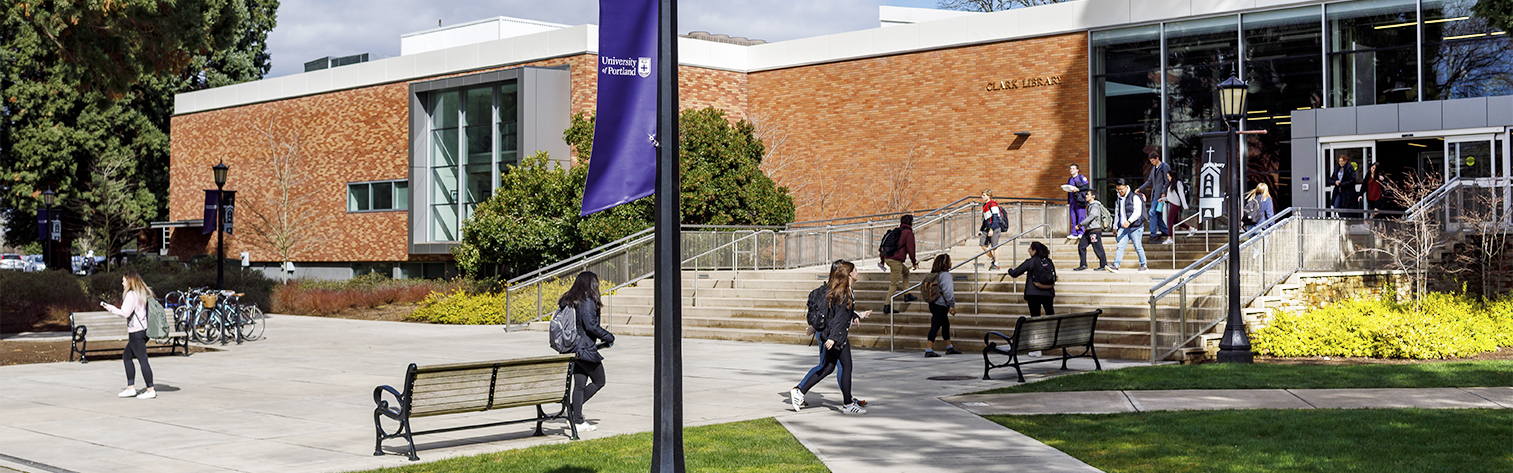
- Wilson W. Clark Memorial Library
- 5000 N Willamette Blvd.
- Portland OR 97203
- 503-943-7111 or 800-841-8261
- fax: 503-943-7491
- library@up.edu
Library: Collection Development Policy
The Collection Development policy below describes the library's core collections. Collection Development Policies are also available for:
Library Collection Development Policy
The library serves the students, faculty, and staff as a dynamic teaching library. Collection development, to meet current and future needs of the University’s academic community, is a pivotal part of that mission. To meet those needs, resource selection and collection maintenance are focused on building and sustaining collections, and securing access to resources that complement and support the degree programs offered at the University.
Collection development, both as a planning activity and service, is impacted by a number of internal and external forces. Institutional budget support, changes in pedagogy and curriculum focus as well as the establishment and elimination of degree programs all have an effect. Fast-evolving electronic resources and the demand for access along with the need to support traditional formats creates collection development challenges and budgetary pressures.
Consortial relationships can influence collection development through such activities as the joint purchase of print and electronic resources, and resources sharing and collection development agreements. The University of Portland Library participates in two consortia, the Orbis Cascade Alliance and NAPCU, which can impact collection development. Orbis Cascade Alliance maintains a union catalog and patron initiated borrowing among members. The library sends representatives to a number of Orbis Cascade Alliance committees, including Committee on Electronic Resources, Collection Development, and Preservation, and the library can participate in consortial purchases of electronic resources. NAPCU allows for reciprocal borrowing among members and, in the past, sponsored joint purchases of expensive microform and print sets.
Collection development, at the University Of Portland is a collaborative venture. Responsibility within the library rests with the Head of Technical Services and Collection Development and the librarians. Each librarian is assigned liaison functions with the primary responsibility for a host of collection development duties including working with departmental faculty, selection of materials, and monitoring of the library allocation for the discipline.
Budget allocation criteria:
The Head of Technical Services and Collection Development, in consultation with the Library Director, sets allocations at the University of Portland Library. The library uses a formula to help allocate its acquisitions budget. The formula was first implemented in 1994 and has been adjusted annually in an attempt to find the appropriate balance of factors. Some criteria are:
- Number of credit hours in lower division, upper division, and graduate courses at the University, with upper division and graduate courses weighted
- Number of full time faculty within each department or school
- Estimated cost of publications, including books, serials, and electronic resources
- Each allocation is then further divided among sub-allocations: books, journals, microforms, reference works, standing orders, electronic resources, and AV/media. These sub-allocations are guidelines rather than absolutes for how funds in each discipline should be spent.
Special policies and collections:
Gifts: The University libraries will accept donated gifts with the prior arrangement of the Head of Technical Services and Collection Development or designee, usually the subject liaison. If these gifts match areas of research and instruction at the University of Portland and meet the collection parameters, they will be considered for cataloging and inclusion in the collection. If already held or otherwise not added, they will disposed of primarily through the library’s own book sale, through exchange, or donated to the Multnomah County Friends of the Library for their book sale. See Gift Policy.
Interlibrary Loan/Document delivery: No library can hope to meet all the information needs of its community, exchange of materials with other libraries and document delivery are necessary service components. The library utilizes a host of services and agreements to provide access to library collections and facilitate resources sharing. These include library to library borrowing, reciprocal-borrowing agreements, Orbis Cascade Alliance patron generated borrowing, and electronic delivery of documents.
Leisure reading: In addition to readers’ advisory as part of reference service, the library participates in the McNaughton’s plan which allows the library to provide a 100 title collection of current and popular literatures which is updated monthly. It also subscribes to popular magazines and regional and international newspapers of interest to the campus community.
Withdrawal, replacement, and preservation: The library does not have a comprehensive policy on these activities, instead maintaining common practice. As a general rule the library only keeps the most current edition of a work, withdrawing previous editions. It was common practice in the past to add duplicate copies; these are being systematically identified and reviewed for possible withdrawal. Although the library has undertaken discipline based weeding in the past, most weeding is done on an ad hoc basis, using criteria such as the appropriateness for the collection, past use of the item, and space considerations. The library carries out some measures to preserve its collection: journal binding, rebinding of books, repair, use of archival electronic databases such as JSTOR, and keeping back runs of periodicals in microform.
Special Collections: The library maintains a Special Collection Room containing items relating to the history and culture of the University of Portland and its relationship to the Congregation of Holy Cross as well as noteworthy rare and exceptional items. Policies governing the development of this collection are outlined in the Special Collections Development Policy.
-
- library@up.edu
- 503-943-7111 or 800-841-8261
- mobile
- Directions & Maps
- 5000 N. Willamette Blvd., Portland, OR 97203-5798
- © 2013 University of Portland, All Rights Reserved