- Admissions
-
Academics
- College of Arts & Sciences
- Pamplin School of Business Administration
- School of Education
- Donald P. Shiley School of Engineering
- School of Nursing
- Graduate School
- Library
- Provost
- Registrar
- Center for Entrepreneurship
- Garaventa Center
- Academic Advising
- Early Alert
- Fellowships & Grants
- Honors Program
- Majors & Minors
- Studies Abroad
- University Catalog: The Bulletin
- Air Force ROTC
- Army ROTC
-
Campus Life
- Arts & Culture
- Campus Ministry
- Counseling & Health Center
- Dining
- Housing & Residence Life
- International Student Services
- Moreau Center for Service & Leadership
- Portland, OR
- Public Safety
- Recreational Services
- Shepard Freshman Resource Center
- Student Activities
- Student Affairs
- Student Resources
- Sustainability
- Services
- Athletics
- About UP
- Home >>
- Library >>
- Find Articles >>
- Moreau Center for Service & Leadership Resources
- Library
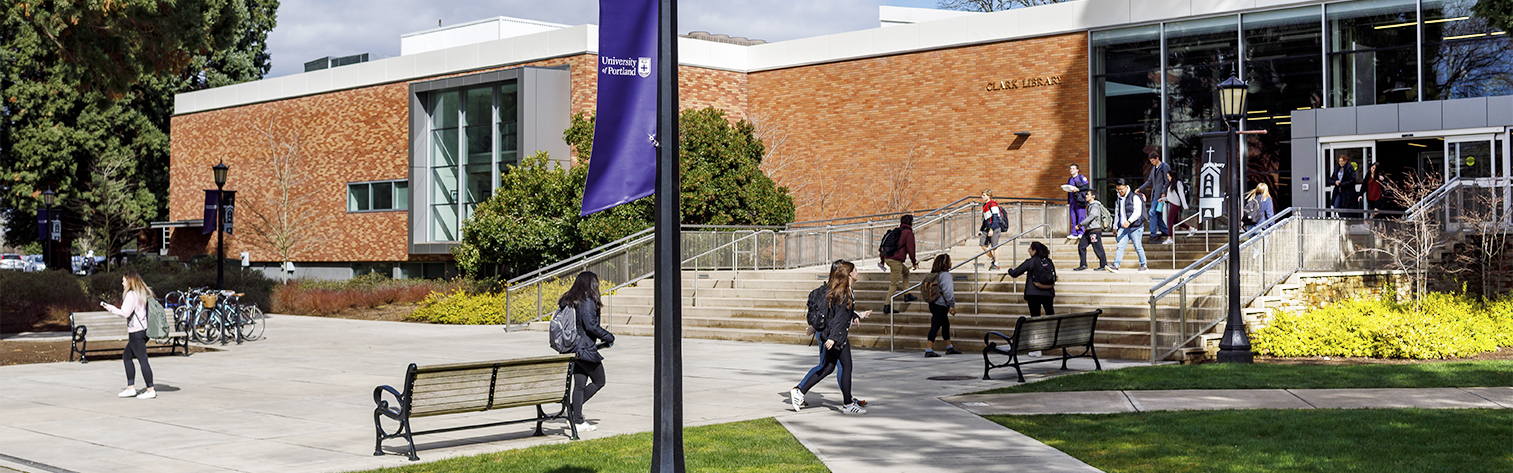
- Wilson W. Clark Memorial Library
- 5000 N Willamette Blvd.
- Portland OR 97203
- 503-943-7111 or 800-841-8261
- fax: 503-943-7491
- library@up.edu
Library: Moreau Center
|
|
In cooperation with the University’s Moreau Center for Service & Leadership, the Clark Memorial Library provides resources to support the Center’s efforts to create a more just, peaceful, and compassionate world. The following items are included on the Moreau Center's recommended resource list. The annotations are drawn from a variety of review and summary sources.
Claiborne, S. (2006). The irresistible revolution: Living as an ordinary radical. Grand Rapids, MI: Zondervan.
Many of us find ourselves caught somewhere between unbelieving activists and inactive believers. We can write a check to feed starving children or hold signs in the streets and feel like we've made a difference without ever encountering the faces of the suffering masses. In this book, Shane Claiborne describes an authentic faith rooted in belief, action, and love, inviting us into a movement of the Spirit that begins inside each of us and extends into a broken world. Shane's faith led him to dress the wounds of lepers with Mother Teresa, visit families in Iraq amidst bombings, and dump $10,000 in coins and bills on Wall Street to redistribute wealth. Shane lives out this revolution each day in his local neighborhood, an impoverished community in North Philadelphia, by living among the homeless, helping local kids with homework, and "practicing resurrection" in the forgotten places of our world.
Ehrenreich, B. (2001). Nickel and dimed: On (not) getting by in America. New York, NY: Metropolitan Books.
Millions of Americans work full-time, year-round, for poverty-level wages. In 1998, Barbara Ehrenreich decided to join them. She was inspired in part by the rhetoric surrounding welfare reform, which promised that a job -- any job -- could be the ticket to a better life. But how does anyone survive, let alone prosper, on six to seven dollars an hour? To find out, Ehrenreich left her home, took the cheapest lodgings she could find, and accepted whatever jobs she was offered as a woefully inexperienced homemaker returning to the workforce. So began a grueling, hair raising, and darkly funny odyssey through the underside of working America. Moving from Florida to Maine to Minnesota, Ehrenreich worked as a waitress, a hotel maid, a cleaning woman, a nursing home aide, and a Wal-Mart sales clerk. Very quickly, she discovered that no job is truly "unskilled," that even the lowliest occupations require exhausting mental and muscular effort. She also learned that one job is not enough; you need at least two if you intend to live indoors.
Hachmyer, C. (2008). Alternatives to the Peace Corps: A guide to global volunteer opportunities (12th ed.). Oakland, CA: Food First Books.
Want to work on a volunteer project that really matters but don't know where to start looking? Alternatives to the Peace Corps is the original resource for finding community-based, grassroots volunteer work-the kind of work that changes the world, one person at at time.
Haugen, G. A. (1999). Good news about injustice: A witness of courage in a hurting world. Downers Grove, IL: InterVarsity Press.
The good news about injustice is that God is against it. God is in the business of using the unlikely to accomplish justice and mercy. In Gary Haugen's challenging and encouraging book he offers stories of courageous Christians who have stood up for justice in the face of human trafficking, forced prostitution, racial and religious persecution, and torture.
Kidder, T. (2003). Mountains beyond mountains. New York, NY: Random House.
At the center of Tracy Kidder's powerful and inspiring book is Dr. Paul Farmer. Harvard professor, renowned infectious-disease specialist, anthropologist, recipient of a MacArthur genius grant, world-class Robin Hood, Farmer was brought up in a bus and on a boat, and in medical school found his lifes calling: to diagnose and cure infectious diseases and to bring the lifesaving tools of modern medicine to those who need them most. This magnificent account shows how radical change can be fostered in situations that seem insurmountable, and how one person can make a difference in solving global health problems through his clear-eyed understanding of how politics, wealth, social systems, and disease interact.
Korzen, C., & Kelley, A. K. (2008). A nation for all: How the Catholic vision of the common good can save America from the politics of division. San Francisco, CA: Jossey-Bass.
On the eve of the most important presidential election in decades, A Nation for All sounds the trumpet to the tens of millions of U.S. Catholics who have refused to buy the notion that people of faith must subscribe to the narrow agenda of the far right. By shining the light of authentic Catholic teaching on pressing contemporary concerns like war, human dignity, poverty, and the looming global climate crisis, this book shows Catholics how their own faith tradition calls them to tackle a sweeping array of issues commonly left out of the faith and politics dialog.
Kotlowitz, A. (1991). There are no children here: The story of two boys growing up in the other America. New York, NY: Doubleday.
One of the surprise bestsellers of 1991, this is the moving & powerful account of two remarkable boys struggling to survive in Chicago's Henry Horner Homes, a public housing complex disfigured by crime & neglect. "Alex Kotlowitz joins the ranks of the important few writers on the subject of urban poverty." This is the moving and powerful account of two remarkable boys struggling to survive in Chicago's Henry Horner Homes, a public housing complex disfigured by crime and neglect.
Lanier, S. A. (2000). Foreign to familiar: A guide to understanding hot- and cold-climate cultures. Hagerstown, MD: McDougal Pub.
If the world were roughly divided into "hot climate" and "cold climate" cultures, what could one half of humankind learn from the other? Lanier---the daughter of missionaries and an experienced world traveler---writes insightfully on topics including relationship vs. task orientation; direct vs. indirect communication; individualism vs. group identity; and different concepts of hospitality.
Mueller, S. L., & Overmann, M. (2008). Working world: Careers in international education, exchange, and development. Washington, DC: Georgetown University Press.
To help the job seeker chart the best course, Working World provides specific resources including annotated lists of selected organizations, websites, and further reading. Profiles of twelve professionals, from promising young associates to presidents and CEOs, illustrate the book's main topics. Each professional provides insight into his or her career choices, distills lessons learned, and offers practical advice about building a career in international affairs. All of these resources were chosen specifically to help job seekers map the next steps toward the internship, job, or other opportunity that will give shape to the career they envision.
Rougeau, V. D. (2008). Christians in the American empire: Faith and citizenship in the new world order. New York, NY: Oxford University Press.
What does it mean to be a Christian citizen of the United States today? This book challenges the argument that the United States is a Christian nation, and that the American founding and the American Constitution can be linked to a Christian understanding of the state and society. Vincent Rougeau argues that the United States has become an economic empire of consumer citizens, led by elites who seek to secure American political and economic dominance around the world. Freedom and democracy for the oppressed are the public themes put forward to justify this dominance, but the driving force behind American hegemony is the need to sustain economic growth and maintain social peace in the United States.
Sider, R. J. (1990). Rich Christians in an age of hunger. Dallas, TX: Word Pub.
Contrasting the affluent West with the needy Third World, the author offers a biblical perspective on poverty and wealth, and practical suggestions towards redressing the world's economic imbalance.
Sleeth, J. M. (2007). Serve god, save the planet: A Christian call to action. Grand Rapids, MI: Zondervan.
Not long ago, J. Matthew Sleeth had a fantastic life and a great job as chief of the medical staff at a large hospital. He was living the American dream until he saw an increasing number of his patients suffering from cancer, asthma, and other chronic diseases. He began to suspect that the Earth and its inhabitants were in deep trouble. Turning to Jesus for guidance, Sleeth discovered how the scriptural lessons of personal responsibility, simplicity, and stewardship could be applied to modern life. The Sleeths have since sold their big home and given away more than half of what they once owned. In Serve God, Save the Planet, Sleeth shares the joy of adopting a less materialistic, healthier lifestyle, stronger relationships, and richer spiritual lives. With the storytelling ease of James Herriot and the logical clarity of C. S. Lewis, Sleeth lays out the rationale for environmentally responsible life changes and a how-to guide for making those changes. Creation is groaning. And Matthew Sleeth has responded. Serve God, Save the Planet is not an alarmist call of despair, but a hopeful invitation to re-imagine the way we live. Sleeth's words have the urgency of an ER crisis coupled with the deep faith that the Church is ready to join God in healing the wounded world.
Wallis, J. (2005). God's politics: Why the right gets it wrong and the left doesn't get it. San Francisco, CA: HarperSanFrancisco
Argues that America's separation of church and state is unrealistic, and maintains that each be held accountable to key values of progressive religious tradition.
Wallis, J. (2008). The great awakening: Reviving faith & politics in a post-religious right America. New York, NY: HarperOne.
Religious faith was a driving force behind our greatest national reforms, such as the abolition of slavery and the civil rights movement. These "great awakenings" happened periodically at crucial times in our nation's history to propel us toward the common good. The time is ripe for another movement that will transform this country. With The Great Awakening, Wallis rediscovers our moral center and provides both the needed inspiration and a concrete plan to hold politics accountable and find solutions to our greatest challenges.
Yankoski, M. (2005). Under the overpass. Sisters, OR: Multnomah Publishers.
Mike Yankoski's journey as a homeless man for five months in an attempt to test the strength of his Christian faith.
For additional resources, see the Social Justice subject guide
-
- library@up.edu
- 503-943-7111 or 800-841-8261
- mobile
- Directions & Maps
- 5000 N. Willamette Blvd., Portland, OR 97203-5798
- © 2013 University of Portland, All Rights Reserved